Monday, January 29, 2007

Evolution has halted

In one of his books (The Story of B maybe?), Quinn said that we have halted evolution.  He only mentioned the idea in passing, and it hasn't reappeared in other books, so I'm guessing he doesn't consider it a key element of his ideas.  Still, it is one that caught my attention. What does he mean?
 
Modern medicine and friends
 
I've heard people say something like this before, but usually it turns out that they just don't understand what evolution is.  They typically mean something like 
 
In the 'wild', people who (can't see / can't walk / have regular seizures / have acute ashma / have low sperm counts / etc.) would not survive to reproduce, thus the human species would tend to select for the opposite traits.  Thanks to modern medicine we allow these traits to continue to occur, and potentially proliferate in our gene pool, resulting in a weaker human population over time.

Or to put it colloquially, "our technology means that the human species is getting worse."  (The problem with that statement, of course, is that evolution doesn't say anything about "better" or "worse" but merely about "more fit" and "less fit" to survive in a given niche.)
 
I don't disagree that this occurs.  In fact, I have an example that is close to home.  My English grandfather was not sent off to fight in World War II, because he had asthma.  While his healthier peers went off & died, he stayed home and had 3 children, all of whom had some breathing issues.  I have some of those traits, albeit mild ones.  The decision to select non-asthmatics as soldiers meant that we selected for asthma in the next generation of the English.
 
However, this doesn't mean that evolution has halted.  It means that the mechanism of selection has changed.  In a hunter-gatherer tribe, the ability to, well, hunt and gather, is clearly critical to survival, so characteristics that interfere with the ability to do those things ( e.g. blindness) are likely to reduce reproduction, and hence their representation in the gene pool.  In modern, civilized society, the criteria are different, but they still exist.  For example, physical attractiveness is still a factor in sexual selection; the ability to eliminate or tolerate certain toxins (e.g., cadmium, mercury) or radiation is more important today than it was 10,000 years ago.  So, evolution of humans still occurs today, and will always occur.
 
Similarly, the characteristics that are selected for in other species have been dramatically affected by the world-wide dominance of human civilization.  The traits of cows are desirable to humans as a food source, so we increase their opportunity to proliferate.  Meanwhile, predators of cows, such as wolves, have traits that interfere with cow's proliferation, so we reduce their opportunity to proliferate.  In these ways, we have a dramatic impact on the gene pools of both cows and wolves on the earth.
 
Now, I don't know for sure what Quinn meant, but I'm guessing this isn't it.  He clearly has a deep understanding of evolution and natural selection -- probably much deeper than mine -- so he probably wouldn't make such a simple error.
 
Food supply limitations
 
Perhaps what Quinn meant was:
 
Consider that civilized humans transform available land from its wild state to a food-producing state.  We do this rapidly and efficiently, thereby allowing us to produce corresponding increases in food supply.  Whereas non-civilized peoples have allowed food supply to limit their numbers ("living in the hands of the gods"), we have effectively removed the limits on food availability for nearly all humans on earth.  In this way, a limited food supply is not a significant factor in the gene selection of civilized people.
 
That seems much more reasonable, and in line with a lot of what Quinn has to say elsewhere, but I still have trouble believing that's what he meant.  Saying that you have "stopped evolution" seems to be a much stronger statement than saying that you have "removed food supply limitations as an environmental selector".
 
Who lives and who dies?
 
Or perhaps he meant:
 
Consider that civilized humans will, without hestiation, obliterate obstacles to increasing food supply for humans.  Cows like to graze pasture, so we'll destroy rain forests extremely rapidly ( 100 acres / minute!), destorying the "inconsequential" life in that area, so that our cows may graze.  If wolves show interest in our cows, we won't just defend the cows when the wolves approach.  We systematically seek out and destroy all wolves, nearly eliminating them as a species, on purpose.  We make the decisions about which species thrive and which are decimated.  For millions of years, the selection was made by a complex mix of natural forces; for the past 10,000 years, we have taken that decision in to our own hands.  We decide who lives and who dies.
 
The gods love diversity
 
Or perhaps even:
 
The universe if full of diversity.  Each blade of grass is unique.  Each plant is unique.  Each mammal is unique.  Each species is unique.  Just as the Law of Gravity is written in every particle of matter, the Law of Life is written in every living thing.  Diversity of life is at the essense of that law.  Diversity of life is at the essense of the theory of natural selection.  Civilized man has dramatically reduced the diversity of life on the earth, by driving some species to extinction, while we allow others to proliferate almost unchecked.  The result dismantles the normal functioning of evolution by natural selection.
 
It's just selection
 
Maybe it's something much simpler.  Wikipedia's summary of Darwin's theory is "populations evolve over the course of generations through a process of natural selection".  Under natural selection, it says:

Natural selection is the process by which favorable traits that are heritable propagate throughout a reproductive population: individual organisms with favorable traits are more likely to survive and reproduce than those with unfavorable traits. If these traits have a genetic basis, then the genotypes associated with the favored traits will increase in frequency in the next generation. Given enough time, this passive process results in adaptations and speciation (see evolution). Natural selection explains why living creatures seem to match their environmental niches so well.

Natural selection is one of the cornerstones of modern biology. The term was introduced by Charles Darwin in his groundbreaking 1859 book The Origin of Species, [1] by analogy with artificial selection, by which a farmer selects his breeding stock.

So, maybe Quinn means "we've stopped evolution by replacing natural selection with artificial selection".
 
Hmm.  This last one seems the most plausible -- it's the one that holds together, and the one that you'd expect from someone who had studied evolution carefully.


Finding hope in criticism

The Ismael article on Wikipedia says this under "Criticism of population claims":
 
Recent population trends indicate a dropoff in fertility rates in most regions in the globe; many demographers claim that increased women's autonomy and access to reproductive technology is responsible for the decrease, and that such trends actually bring fertility below the " replacement rate" in many industrialized nations. Some argue that people in industrial societies have less of an incentive to "over-reproduce," as children are a net economic drain, unlike in agrarian societies. In this view, it is possible that population levels will become self-limiting if high rates of reproduction become irrational and avoidable.
 
It's an understandable criticism, and Quinn's response is described in that article.  However, there's something else here.
 
It is true that in industrialized nations aren't growing their population the way other parts of the world are.  While the potential reasons are concerning
  • too busy conusming products and media to breed
  • too busy working to pay off the debt from the former
  • exposed to polutants that interfere with fertility or libido
there is some hope.  You see, people in these countries aren't sitting around mourning their lack of reproduction.  They aren't crying in the streets because they didn't have any kids.  For the most part, they're perfectly content to not be reproducing so much.
 
That's where the good news lies: there is a way to get civilized people to avoid reproducing in such large numbers.  Something in their life is pushing a button that gets them to choose not to reproduce so verbosely..  Now all we need to do is find another way to push that same button -- a way that doesn't involve the incredible consumption of natural resources and production of pollutants.
 
(Flash-forward: In Beyond Civilization, Quinn has a proposal for a way to address the ills he describes in his earlier books.  Perhaps that proposal can succeed because it is able to push this "don't reproduce so much" button, without the undeseriable consequences that Quinn points out in response to the criticism above.)
 

Is mass starvation the answer?

When I first read Ishmael, it took me a lot of contemplation to make sense of what he was saying. These are ideas that conflict directly with what we hear every day, everywhere we go. I'd heard the same message since I was very young. Anything else was difficult to understand at first.

Today, I think I have gotten past the initial hump, and can at least articulate what I believe Quinn is saying. Most of what he said in Ishmael seemed pretty reasonable to me. The ideas are not complex, even if they are outside my normal arena of thought.

However, there was one bit that I got stuck on.

He talks about the relationship between food supply an population. That for any population of a given species, if you increase the food supply, the population will grow to match, and if you decrease the food supply the population will shrink to match. He says this is true for all species, and that includes humans. What our culture has done, via Tolitarian Agriculture, is to continually, and dramatically increase our food supply for 10,000 years.

He also makes a strong case that this behavior is a problem - that it's not sustainable. In fact, we have long since past the point of sustainabilty. To attempt to maintain current behavior will result in our extinction, and soon -- Quinn says 100 years if we keep going the way we're going.

When I read this, I thought it sounded like Quinn was saying we should reduce the food supply available to humanity, which would in turn reduce the human population. That is, people need to get busy starving to death .

Well, that's not something I can accept very easily, for a number of reasons:

Starving hurts. Really, it's a terrible way to go. I hate it when dinner is late; I can't imagine the agony of dying of hunger.

Who decides? Some will go hungry, while others eat enough. Who chooses? Judging by our past behaviors, it will be the elite that chooses, and they will choose themselves & their friends to eat. That is, the haves will have food, and the have-nots will not have food. The fact that I would almost certainly be in the 'haves' is no comfort to me. Anyway, this is something that no one has the right to choose. As Quinn says, "who lives and who dies" is a matter for the gods; the fact that we think we are wise enough to make that choice is the reason we ended up here in the first place.

The system would be abused. Duh. No matter how fair the system could be, someone will use their power to abuse it.

Still, perhaps we can convince ourselves that it's OK for mass starvation to happen, because:
a) today lots of people are already starving
b) the result would be "better for humanity"

But then I consider:

It's only temporary. If we could reduce the human population by 90% this way, the remaining 10% would have little motivation to stick with the program, and our numbers would grow again. We're doubling every 37 years, so it would take a bit over a century to restore the current population.

Then I consider what I think I know about Quinn. He is not trying to deliver a doomsday message, but instead a message of hope. It just doesn't seem to fit him to say that he's suggesting we starve 90% of the population. He must have a better idea in mind.

Sunday, January 28, 2007

more Quinn

After reading Quinn's Ishmael trilogy, I was looking for more content. I put a hold on the rest of Quinn's work at the library. 2 items appeared right away, and of course I consumed them in short order.


The first was Tales of Adam, a series of short parables about a man in a hunter-gatherer tribe, teaching his son the lessons of life.


The second, entitled An Anamist Testament was a pair of cassette tapes of Quinn reading his work. The first tape was Tales of Adam. The second was The Book of the Damned.


It was interesting listening. They reflect many of the same ideas that appeared in Ishmael, but from a different perspective. Where Ishmael is written for someone civilized who is new to these ideas, these tapes seem more appropriate with someone who has already digested Ishmael.


Now that I have consumed 6 titles of Quinn's work, am I an expert? Far from it. I'm working hard to probe his ideas, and re-evaluate my thinking with this new perpective. It's slow going. Luckily, my wife has also read some of his work and is interested in talking through this stuff.


I hope to have a little time to blog about my thoughts.

Wednesday, January 24, 2007

Tips for living simply #4 - if you get stuck, cheat

When I first started getting rid of stuff, it went quickly.  There was lots of trash collected everywhere.  Just putting it in the trash can made a big difference.
 
Then I started getting rid of things that I knew I didn't need.  For example, I had 3 motorcycles but rarely rode, and 2 of them didn't even run.  I gave the broken down bikes to a high school auto shop class.
 
More recently, I got stuck.  I could see that there was plenty of stuff to filter through and discard, but the real reason I was stuck is that there was even more stuff in the house that I didn't know what to do with, specifically kids stuff - toys, books, etc.  I know how to deal with my stuff, and am willing to make the decision to deny myself an item I might want to have on hand (say, a spare hard drive) in exchange for the clarity, simplicity, and comfort that come with having an uncluttered, managable home.  However, I was not comfortable making that same decision on behalf of my kids.  How can you take away your kids toys?
 
At the same time, I knew the toys were a problem.  The twins are nearly a year old, and are more than capable of putting out every toy in the house in just a few minutes.  They are, of course, completely unable to put them away.  It then takes me 20+ minutes to put all those toys away, assuming I sort them out properly - legos in this box, blocks in that box.  (If I don't sort them, instead just tossing them in to a huge bin, then there's no way anyone can find a complete set of somethign to play with.)
 
I knew that we had too many toys, but how few is too few? For most of human history - millions of years -- children grew up without any toys to speak of, and presumably they still had fulfilling childhoods, and became well-functioning adults with fulfulling adulthoods.  Even today, I see that my children use play to learn about the world around them, but they often use items that are not specifically designed to be "toys" but have some other purpose.  This makes sense, as what children are trying to do is learn about being a person by mimicing their parents, and their parents are using hammers and forks and pillows and cars, not legos and dolls and blocks and marbles. 
 
In fact, this is the essense of unschooling - that children learn because that's what children do, not because someone teaches them.  This is the natural way of things.  You don't have to fight it, or force it.  You also don't have to ignore it - you can facilitate it.  You can make sure that children have opportunities to explore what they want to learn about, and trust that they will learn, and enjoy that learning.
 
So, it seems that the minimum number of toys for a healthy childhood is zero. (Can you see my reasoning?)
 
I started grabbing complete toys and removing them from the scene.  I prioritized toys that were not completely age appropriate for our kids today, and toys that were in complete sets in their own containers.  These I carried out to the shed.  I did this until I got tired of it.  
 
Suddenly there's a lot more room in the house, especialy in the rooms we use the most.  The toys we still have around are well-used.  After the kids have played in a room, I can still walk through it without breaking something underfoot.  I can clean up after them in a reasonable amout of time.
 
The title of this post suggest cheating, which is exactly what I've done.  We still own a lot of things we don't need, and we're perhaps ignoring the problem by putting them in the shed.  That's still better than keeping them in the main living areas.  It means we're acutally a step closer to getting rid of those toys entirely, if we decide that we like the way things are now better than before.


Monday, January 22, 2007

Reid likes pizza


Yesterday Reid & I went on one of our adventures. Before the twins were born, we used to do this pretty often. We'd pick a museum or something and catch a couple busses to get there. Good parent/child time.

Yesterday's involved a long ferry ride. I didn't let him eat on the boat because he was experiencing some motion sickness. When we arrived we decided to eat at a pizza joint. Reid ate a large slice, and insisted he was still hungry. The second slice was even bigger, so I grabbed this snapshot.

Friday, January 12, 2007

OK, I'll write

Lee also says:

You solve problems all day. Even if it’s a relatively simple solution
(script, house repair tip, way to get better gas mileage,) write about it
anyways. Those looking to solve that same problem in the future will thank
you.

OK, here I go:

script

My PowerShell prompt:

function prompt{
Write-Host ("PS " + $(get-location) +">") -nonewline -foregroundcolor Magenta
return " "
}

house repair tip

If you decide to run new low-voltage wiring (like ethernet), go ahead and pull way, way more than you think you need. The work to pull the first wire is huge. The additional cost to pull a bundle is small. I recently pulled:

  • Cat-5e (ethernet)
  • Cat-5e (phone)
  • Cat-5e (spare)
  • RG-6 (video)

Now I think I should have pulled another RG-6, which people seem to like for satellite.

I'm wondering if I can use the spare Cat-5e to run line-level audio for whole-house music.

(Great thanks to my brother for doing the messy under-house work.)

way to get better gas mileage

Don't drive. Walk, bike, bus, or don't go in the first place. This is so much more effective than anything else I can offer.

When I do drive, I've picked up the following highly annoying habit: I go really slowly up hills. Specifically, I try to take it easy on the gas up a hill, even if that means I gradually lose speed. With an automatic transmission, I try to keep as much throttle on as I can without it downshifting. This does seem to annoy other drivers, so I try to do it when there's no one right behind me.

When I approach a red light, I get off the gas way, way early, which saves some gas. I'll even brake a little, from far away, in order to still have some momentum when the light goes green and other traffic starts to move. This doesn't make me any later, but somehow it still pisses off the other drivers, who then drive harder to get past me. So it may be a net loss.

Lee on Writer's Block

I just read Lee Holmes' post entitled Break your Writer's Block. He's right, and I think his suggestions can help me get blogging again.

My favorite quote:
you’ll find that you can produce more random junk in a minute than you could
have imagined.

It's true!

I read Lee's blog because he works on PowerShell, which I just mentioned. Neat.

I am B

Years ago I read some Daniel Quinn. I could tell he was saying something important, but I couldn't figure out what it meant or what to do with it. I'm not sure why, but I just wasn't ready for it, I guess.

In November I read Providence, which touches on a bunch of his ideas in a shorter space. This time it really clicked, and I decided it was time try again.

For Christmas, I asked my wife to get me. Two by Daniel Quinn: Ishmael and The Story of B . Two by Patrick O'Brian: HMS Surprise and The Mauritius Command . However, I hate the way that the Christmas giving obligation drives us to spend, consume natural resources, create trash, etc. So I asked her to get them from the library if possible, or used otherwise.

So, in the last 3 weeks I have read Ishmael, the Story of B, and My Ishmael (which I already had a copy of from my previous experience). I hadn't read B before, because someone told me it was about religion, and discussion religion usually bores me to tears.

Ishmael struck me again. I came away with one big question: if we need to quickly, drastically reduce human population in order to make room for some other life on the planet, and we assume that population is directly linked to food supply, then we must reduce the amount of food humans are consuming, just as quickly and drastically. This makes perfect sense at the species level, but I have trouble with it on the individual level. I'm not willing to let someone I care about starve just because I think there are too many people. Furthermore, I'm not willing to decide that the people I care about shall be well-fed, while the have-nots go hungry, even if I do believe it's somehow for the good of the species and the whole planet.

What I'm really run in to here is the one of the fundemental issues that Quinn is pointing to: the fact that I, as a "Taker" think that the decision of who lives and who dies belongs in the hands of man. I read him as saying that I must make that decision, but I sense that he's not saying that at all.

The Story of B was much better than I expected. The religious aspects did not bore me at all, and the story was damn interesting. In that way it kept my attention better than any of his other books that I've read. The message that changed minds are required is important. I may not know how to change the way we live, but perhaps I can spread the understanding that a change is necessary, and why.

My Ishmael was fine for me, until the narrative at the end. I think I understand why it was important for some people, but for me I was not so interested in that part. I was looking for insights, and the story involved characters I didn't care about very much, since we hadn't really met them as people in the first part of the book.
The increased focus on "moving forward" and on tribal, not hierarchical structures for humanity is clearly important, and something I can lean on to help me in the future.

The next book to read is Beyond Civilization, which I read 2 years ago. You can see the impact it had on me in the Christmas Spirit post I linked to above. I don't have my copy any more (loaned it out, I think). Time to find another copy. After that, it's on to his latest book, If They Give You Lined Paper, Write Sideways, which is very, very new. I think I'll read it, too.

PowerShell is awesome

I want to declare my love of PowerShell to the world.
 
Done.

What is the Yoga of Stretching?


A while back I read The Yoga of Eating. It has had a lasting affect on my. Not just on my way of thinking about food, but on my understanding of Yoga itself.

One example of my learning: I realized that if I'm going to get physically fit, I need to find a way to do it without it being work. Going to the gym for an hour and doing the stairmaster just doesn't work for me. I know I won't do it. What I've done instead is integrate activity in to my life in a way that meets other needs as well. For example, I bike my son to school. I enjoy our time together, and I like the oddness of it.

One aspect of my physical health that is pretty far from where I want it to be is my flexibility. I can't remember ever having been able to touch my toes without bending my knees. Heck, I can't remember being able to reach my ankles.

I find that I don't really enjoy stretching. I've taken yoga classes, but they are more like aerobics classes with a different set of movements. The Yoga of it seems lost. Instead, I'm trying to find an activity that is interesting for some other reason, and will improve my flexibilty.

The only thing can think of so far is swimming, but I'm not sure. Does swimming make you more flexible?

Any other suggestions?

Edit: This page: http://www.thefactsaboutfitness.com/research/oldstretch.htm seems to suggest that they know something interesting, but they aren't saying what unless you pay. And I ain't paying.

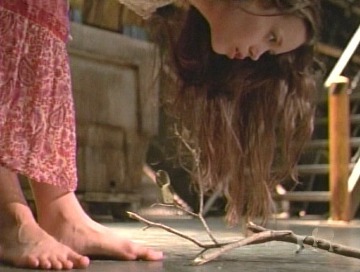
Edit 2: When I imagine "flexible", I think of the opening scenes in the Firefly episode Objects in Space. River walks in to the cargo area, and bends over to consider an object on the ground. She could probably put her forhead on her shins.

Thursday, January 04, 2007

recent ferments

The folks that came to visit us in December were fermentation-friendly.  They were willing to try anything I had made.  Seemed like a good time to break out the things that were hiding in the corners.
 
wild blackberry wine
 
Last summer my brother and I picked about 2 quarts of wild blackberries on the side of the road.  I ran them through the blender to make a juicy mush, about 1 quart.  Added 3 quarts of water.  I probably dumped in a cup of some other ferment that was already going in the kitchen, but I don't remember.  Let it ferment in a jar for a week or two, then moved to a narrow-mouthed jug with an airlock.  Put that in the back of a closet until last week.
 
It was good, but not great.  Biggest problem is that there was too much water.  I probably should not have added any, and just gone with the juice.
 
mead
 
Water & honey, in a 4:1 ratio.  Stir often until fermentation gets active.  Once it settles down, bottle.  Let it sit in the back of closet.
 
Excellent.  Each bottle is a little different.  Some are dry, some are sweet.  All are very fizzy, with tiny champaign-like bubbles.  Everyone loves it.
 
I've decided to make lots more of this, and make it more often.  I have a quart of it sitting on the counter now, which I stir often, trying to get a good culture.  It doesn't seem to be going well, so I think I'll need to start over.  Once I have a good bubbly mix, I'll be making a bunch.
 
I'm thinking of a two-week cycle.  Every other weekend I bottle what I have, saving a little to start another batch.
 
I may need more bottles.
 
sauerkraut
 
Before my thanksgiving trip I started some kraut.  I had 3 heads of cabbage sitting in the fridge that I couldn't find time to make.  With the trip coming, I decided to take shortcuts.  I cut the heads in to big peices, no where near the shredding that is common with commercial sauerkraut.  Salt, in to crocks, add some water to cover.  As an experiement, I kept the heads intact and put them on the bottom.  It's like a prize. :-)
 
They turned out really well; the kraut is very crisp.  Plenty of people are enjoying it. I look forward to having a generous cellar one day, where I can keep gallons of kraut around all winter.


--
-Jay

Seattle Storm

Mid-december there was a big windstorm in the Seattle area.  Lots of people had it pretty bad.  Power out for a week, no heat, and the weather was cold.  Or trees fell through their homes.  Stuff like that.
 
We didn't have power for about 2 days, which sucked while it happened, but seems mild by comparison now.  We didn't really have a good source of backup heat.  We have a fireplace that we hadn't used ever, even though we've been in the house 9 years.  We collected scraps of dead branches and some old rotten logs, and tried our best to bring in some heat.  It made a difference, but damn it was cold.
 
The next day we heard that friends in the next county had power, and invited ourselves to go visit.  Thanks Kevin!  That evening we got power back, and headed home.  The house was a total mess, as we hadn't done any cleaning for 2 days, and there were wood chips everywhere.
 
The next day we heard that some friends were hiding out in Canada, because their home didn't have power yet.  We invited them to come join us, which they did.  They stayed with us for 2 nights, and I really enjoyed having the company.  Then my brother-in-law and his fiance arrived, for the holidays.  A few days later my sister-, mother-, and father-in-law arrived.  We had 10 in the house for a while, wow!  The last of them left on the 31st.  Now the house is pretty quiet, and empty.  The full load of parenting is back on our shoulders, but we're doing OK. 
 
One tree fell in our yard.  It was about 100 ft. tall, but only 50 years old.  Fast-growing, I guess.  The folks I talked to said it was a "theadora", which I've never heard of.  The tree fell leaning up against the neighbor's tree, knocking the top off that tree, which then crashed to the ground with a big thud.  The only real damage was a bit of fencing.
 
We paid a small fortune to get the leaning tree taken down, so it wouldn't fall further and create more damage.  Now our backyard is a big mess, with enormous logs that I can barely move and a deep covering of branches.
 
I'm waiting for insurance stuff to work out, in the hopes that they'll pay for the cleanup.

Gee, I wish I was blogging

I haven't been posting much over that last year, for two reasons. If you're a parent, I'm sure you understand how much work it is to have an infant in the house.

If you're not a parent of twins, consider this: with a single baby, there's usually one parent busy with a baby, and one that has both hands free for other activities. When the busy one needs both hands free, they can trade.

With two babies, both parents are usually busy with a baby. If one needs both hands free, the other parent has to take both babies, which they can only do for so long.

It's certainly not as hard as it was when 6 months ago. Today the babies like to play on their own (emptying kitchen cupboards, for example) and that gives us time to do other things (yay, a shower!).

I know that some people have an even harder time of it than we do. Some people have triplets, or more. We have friends that had two sets of twins. Some people parent alone. Some don't have the option to have a parent stay at home with the kids. Many struggle just to get enough money to get by.

I'm very greatful to all the family that has come to visit & help. My wife's parents have come out 3 times in the last year. My brother & his girlfriend moved in with us for 16 weeks! My dad, my siblings-in-law, and my wife's high school friend have all come out for a week or so. It has made a huge difference. I wish my mom could have.

Well, I have plenty of things I want to blog about, but not enough time to write them the way I want to. I think I"ll try just whipping them out quickly, and see how that goes.

Friday, December 01, 2006

Back home


Spent another Thanksgiving week in the Far East. The trip back took longer than norbal, in part due to Seattle weather. The kids fell asleep in the shuttle.

Reid slept this way the whole night.

Thursday, November 30, 2006

let's hear it for boobs!

It's a bit out of date now, but a couple weeks ago a woman was hassled on a plane because she was breastfeeding her child.

People are worried about what effect it will have on kids to see people breastfeeding. They don't worry about what effect it will have on kids to see people bottle feeding.

What effect does this have on kids? They learn that bottle feeding is normal, and that breastfeeding is not. Backwards!

Every time I think of someone saying "shame on you" for showing boobs, I want to say "shame on you" to someone for showing a baby bottle.

The article I linked above is sub-headed with "Files complaint saying she was being discreet, airline disagrees". I think that misses the point: discretion is counter-productive here.

Hey moms: if you're breastfeeding, don't hide it! Sure, I know you can do it discretely, but I encourage you to do the opposite. Make sure everyone can see what you are doing with your boobs.

When baby is hungry, don't whisper to your partner "honey, he's hungry". In a full voice, declare that you're going to feed your baby. Take your top & bra off before you latch on. Boldly demonstrate your technique. Sit in the middle of the room. On a stool. In the light.

Don't be ashamed of it, be proud! Make sure everyone knows how proud you are of what you are able to do for your child. Set an example for all the girls that see you ("Oh, I can do that when I'm a mom one day") and for the boys ("Oh, when I'm a dad one day, the mom of my child can do that"). You're doing them a great service.

Don't hide it, flaunt it!

With that in mind, here's a link to the Wikipedia article on breasts: http://en.wikipedia.org/wiki/Breast. I love the fact that Wikipedia doesn't self-censor around sex. That page is filled with boobs.

Let's hear it for boobs!

2 disclaimers are in order:

1) none of my 3 children were exclusively breastfed, but not for lack of trying. I can't attempt to take the holier-than-though attitude of saying that everyone should breastfeed, period. Instead, I know that it can be very hard, and may not always work out. But part of the reason is that as a breastfeeding mom you are isolated, shunned, and shamed, so it's hard to get the emotional and logistical support you need. If we celebrated & displayed breastfeeding, it would be easier to get that support.

2) I enjoy the appearance of breasts, and I do mean sexually. So I could just be saying this so I can see tits more often. It's nice when my various interests align.

Monday, November 20, 2006

Dylan takes a step; Zephyr stacks.

Moments ago Dylan took his first step.
 
When Reid started walking, he was very excited. He'd pull himself up and launch himself in the direction he wanted to go.  His face full of a huge smile, he'd take a few steps before he lost his balance, crashing to the floor in a fit of laughter.
 
Dylan has been balancing on two feet for over a month, and "cruising" for about as long.  (The term "cruising" describes the way babies will hold on to the edge of objects for balance while they get around on two feet).  Only a couple days after he started balancing with no hands he started crawling.  We had been worried he'd skip crawling all together, but instead he quickly became a speed-crawler, far outpacing his twin brother.  It was interesting how he learned two new skills in such quick succession.
 
Just a few minutes ago, Dylan was standing on two feet without holding on to anything, and decided he was facing the wrong direction.  He carefully shifted his balance, picked up one foot, and moved it.  Then he did it again, and again.  Then he decided he was done, and sat down to keep playing.  He didn't even seem to notice that he had taken his first steps.
 
In keeping with the 2 new skills pattern, he just started doing stairs, too.  We keep the stairs at home blocked off, so the babies don't get to practice.  But we're on vacation in a 3-story house at the beach.  Dylan discovered the stairs and now practices them regularly.  He will crawl from the ground floor to the loft above the 3rd floor without a pause.
 
Zephyr, weighing 5lbs more, gets an "A" for effort.  He sits at the bottom step and strains and makes a lot of noise and tries to get his feet in different position, but doesn't get very far. 
 
I don't want to give the impression that Zephyr isn't learning.  Last week he was putting a long toy block in an empty jar and figuring out why it wouldn't come out in certain positions.  Yesterday he found a set of coasters and started putting them away in their tray.  Today he started stacking things.  Right now he is looking at a rubber ducky that is trapped in an otherwise empty Animal Crackers tub, trying to figure out how to retrieve it.
 
Fun times.

Tuesday, November 14, 2006

Food in the large and in the small

An email about "The real cause of E. Coli in spinach" got me thinking, and I ended up writing this:
 
We should remember that as food production scales up, so does risk.  It's nearly impossible to ensure that every person involved in a large-scale process is careful and concientious about the work they do.  And when they make a mistake, the impact is likely to be wide-spread as well. 
 
When we turn to local, independent food producers (like I do with my milk), we reverse that equation.  We can get involved in our food sources.  I met the cows over the summer, which was awesome.  The food we get is fresher, more flavorful, and more nutritious.  It travels much less distance, is handled & processed less, and generates less polution.
 
It makes sense that large-scale food be regulated carefully by government.  At the same time, we need to be careful, as regulatory agencies can easily be co-opted by the revolving door, as regulations are never sufficient to guarantee safety (let alone quality!), and as rules can miss the relationship between risk, costs, and scale, thereby driving even more food production in to the less-safe realm of the multinational corporation.
 
I've been reading Sandor Ellix Katz' new book The Revolution will not be Microwaved: Inside America's Underground Food Movements, and am really enjoying it.  Every page I read gets me fired up.
 
I'm glad to be getting eggs, milk, cream, and butter via Stan the dairy farmer.  The power of the "share" model is incredible.  It makes direct-from-the-farmfood available to us, even in the face of regulations that don't fit, like a rule that says that it's dangerous to drink milk from a cow, unless it it first boiled, chilled, shipped, sold, shipped again, and sold again.  Weird.
 
What else can I get via shares?  I'd love some homemade sausages & bacon.  Mmm.

Friday, October 20, 2006

Carfree spaces

I think that I would enjoy living in a carfree area a great deal. I find these attributes very attractive:

  • cleaner air
  • less noise
  • closer-knit communities
  • safety, especially for children
  • better exercise for everyone
  • having less stress, and living around people with less stress
  • getting what we need locally (instead of from oil far away)
  • reduced dependence on government, major industry, and infrastructure

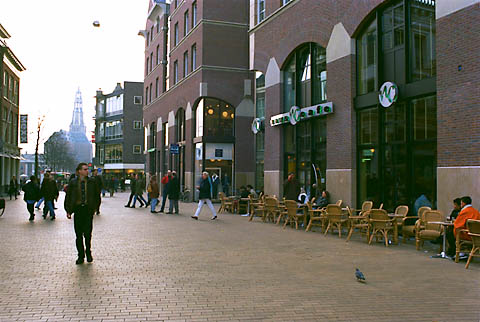
I saw this picture at carfree.com, and found it beautiful:


Center of Groningen, The Netherlands
Part of the large nearly carfree center.

I read through the Wikipedia article List of car-free places with great interest, only to discover that the U.S. has very little to offer. Basically, Mackinac Island and Fire Island are your only real car-free options.

There is some mention of massive pedestrian shopping malls, but that's not what I'm looking for. It's not about shopping!

Why don't more cities have car-free spaces? Why doesn't each major city pick one district and make it car-free. Over time, some people will migrate in, and some will migrate out, depending on their taste. In 10 years, you'll know if you should grow it or shrink it.

For the Seattle, I propose Broadway on Capitol Hill.

How much can you do on a bike?

Bikes at Work has some impressive examples:

delivering 10 bags of groceries plus 15 rolls of paper towels and 70 packages of toilet paper

And I thought pulling 3 kids was a lot!  So now I'm all excited about how much I can do with a bike, instead of using the car.  If I can keep up the riding through the winter, then by spring I should be in good enough shape to start taking on a bit more.

What else can be done on a bike?

Bicycling a lot

Can it really be so long? 14 years?

When I was in high school, I started bicycling a lot. I rode to school every day. It was only 2 miles each way, but it made a difference. My dad & I would go for 30 mile rides each Wednesday, in the hilly Appalacians. A couple times we did the MS150, a fund-raiser ride for 150 miles in 2 days. I weight about 180lbs-190lbs, and didn't think about it at all.

Then I went to college, and stopped riding. I started smoking, made things worse a lot faster. I gained about 10lbs / year for a while.

Eventually I quit the smoking, but it was only this past spring that I really got any regular exercise. (a few summers ago I started doing a bit of exercise every day, mixing it up - swimming with my son, walking to/form work, in-line skates. I lost 15lbs from my peak of 280lbs, but the habit didn't stick when the weather changed).

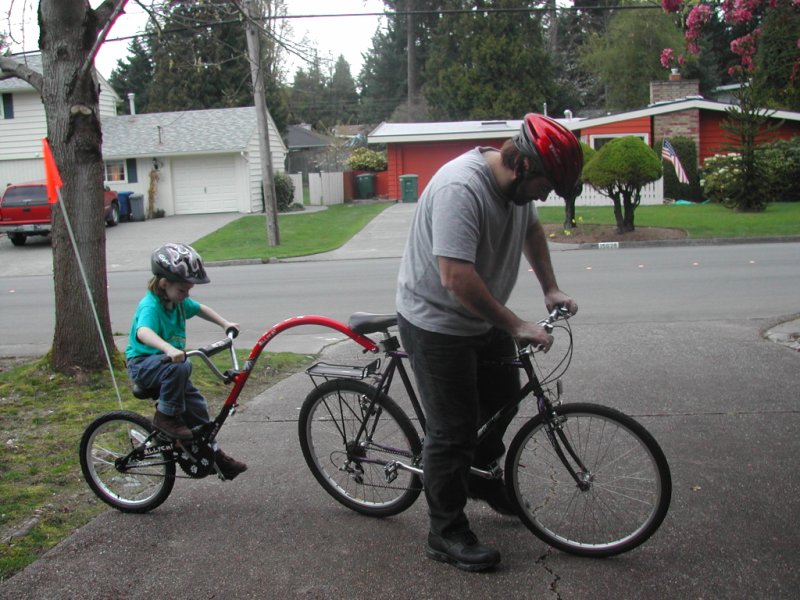
However, for the last 6 months, I have been bicycling pretty regularly. I got a tandem attachment for my bike, and ride with my 5-year-old to school in the morning. I drop him & the tandem off, and then bike the rest of the way to work. I then pick up the tandem on the way home. It's a total of about 40 minutes of exercise each day.

I haven't lost much weight - maybe 4lbs in that time. But I can tell that I feel stronger, more able to move around. I am hopefull that as I continue to the biking habit I will continue to get fitter. I have 14 years to undo!

A couple weeks ago we picked up a kid trailer for the bike, too. One that can carry the twins. I attached it to the tandem trailer, so I now have a "bicycle" with 5 wheels! The trailer is way back there, so I bought a bunch of lights to make it a bit more visible. The seem to love the rides, which is a huge improvement over car rides, when they scream the whole time.

Last night the babies bike helmets arrived. They're a bit too big for their 8-month-old heads. Maybe I'll wait until the spring to take them out, when the weather is nicer and their heads have grown.In the meantime, I pull the trailer around whenever I ride with the tandem, so that I can build more strength and get some practice handling the rig.

I'm really enjoying it.

Monday, October 16, 2006

The money thing

So, I did end up creating a blog about my personal finances.  I couldn't really decide if it was important to be secret about my identity or not.  It bugs me that we have all these social rules about keeping secrets, mostly about sex & money, two things that seem to occupy our attention a lot of the time.
 
I didn't make it anonymous because I believe it's important to keep it secret.  I made it anonymous because I couldn't decide, but I know how to go from anonymous to onymous, but not the other way around.  That is, I took the "safe" bet.
 
If you are a reader of this blog, and would like a pointer to my money blog, drop me a line.

Wednesday, October 11, 2006

A very successful cheese

Last week I still had a 1/2-gallon of milk left over when the week's delivery of fresh milk arrived.  Remember that this is excellent raw milk that I get straight from the farmer.   This 1/2-gallon had gotten pretty sour, and no one was interested in drinking it.  But I didn't want to throw it out.  So, I decided to try an experiment.

I put the jar on the back of the stove, and left it.  After a few days it had "clabbered", or turned semi-solid.  Similar to yogurt.  As it continued to age, the acid that was produced by the naturally occuring bacteria caused it the clabbered curds to separate from the whey.

When the separation was significant (and when the babies gave me a chance to work on it), I moved the curds in to a cheesecloth, and hung it up to strain.  I left that for another day.

What I found inside was thicker than yogurt, but not as thick as store-bought cream cheese.  Close to the texture of chevre.  I added salt (which I should have done earlier, probably), and some powdered garlic.  It was in the middle of the night, because a baby had me up, and I didn't have a lot of light, and the cheese, garlic, and salt are all about the same color.  I have no idea how much I put in.

Mixed it up & tasted it.  Delicious! 

The other adults in the house loved it, too.  Last night I toasted some bread to make it crispy, and we spread it on.  Mmmm.

Wednesday, October 04, 2006

An open wallet?

I have seen a couple interesting blogs where people talk in detail about their personal finances.  For example, My Open Wallet.
 
I think that my finances are slightly unusual (thanks to working at Microsoft), and my approach to managing it is sometimes unorthodox (just like everything else I do).
 
It's strange to me that the most secret of secrets is how much money you make. 
 
So, should I start writing about my finances publicly?
 
Should I do it anonymously?
 

Tips for living simply #3 - It's not about products

When I started down the path of simplifying my life, I decided to do some research on the internet to see if I could find some help.  One of the things I came across pretty quickly were web sites dedicated to simplicity.  What was disappointing about many of them was that they wanted me to buy products to simplify my life.

Yeah, that's right.  Got a problem with stuff in your life?  Here's some more stuff to help you out!

There's a pretty big industry for simplicity products.  That fact is quite telling about the nature of the society I live in.  And it's quite disturbing...

Even beyond the simplicity industry, many products offer to simplify your life. It's a common advertising ploy, but usually an absurd one.  Like a credit card or a vacation would solve the fact that you are in debt and don't have enough time to keep your home in order.

There's another issue with products, at least one that I'm deeply concerned with.  Things that are produced for the mass market seem to conflict with the dreams that I mentione before.  They are made with plastics, or in sweat shops, or have to be transported a long, long way.

Despite the message of advertising to the contrary, they're not produced to do me a favor. The purpose is to get some other guy rich.  He's not likely trying to help me and help himself at the same time, but trying to help himself, no matter what it might cost me.
 
So, watch out for products.  You probably don't need the one that you're looking at right now...

It's about time...

I had this thought:
"I'm in no rush to invent a time machine"

Thursday, September 28, 2006

Tips for living simply #2 - don't go too far

This is really a corollary of know your dreams. You could get rid of just about everything you own, and live in a practically empty space. Think of Jack's parent's home in Brokeback Mountain. Or you could get by with just enough to fit in a backpack.

Those are interesting possibilities, but for me they aren't realistic. (Maybe they are for you though. Tell us about your experience!)

Just remember that your goal isn't to get rid of everything in your life. It's to get things out of the way of achieving your dreams.

Tips for living simply #1 - know your dreams

A few years ago I realized that the stuff in my life was reducing my happiness.

I had 3 motorcycles, but only 2 of them worked. I didn't have time to fix the broken ones. I rarely rode the one that worked.

I had a large collection of tools that I aquired while working on the bikes. Some of the tools I had never used. Some of the tools I had never opened!

I had so many tools, that I couldn't remember what tools I had. So I would sometimes buy a second of a tool I had, because I didn't know I had it.

Similar patterns appeared in all of the stuff in my life.

When you turn your attention to simplifying your life, you will regularly hit some difficult question. When you can't clearly see the way through the choice, it helps to know what your dreams are.

I can't say that I have a clear, concrete description of my dreams, but I know parts of it:
- Be present with my family, giving them the best part of me
- Live in harmony with nature
- Bond with a community around my family, with deep, meaninful relationships
- Have lots and lots of fun
- Always be learning new things

The goal of living simply, when put in this perspective, starts to make more sense. I could get rid of all the things I own, except for what fits in a backpack. That might give me more opportunities for fun & learning, as I travel & meet people that I can form deep relationships with. It could easily enable me to live in harmony with nature, if I consume very few resources. However, it would interfere with the first item, as my family would like the comfort of a house with a kitchen, etc. I would also miss out on the fun of writing software, reading Wikipedia, playing Half-Life 2, and internet porn.

For now, I am keeping the basic things the same - I have a family, I own a house, I own a car (2 actually!), I work a regular job, I have computers and a TV. But around that I have gotten rid of tons of stuff. There's still a lot more to do, so I'll try to keep writing....

Monday, September 11, 2006

So much milk; let's make cottage cheese

Due to some changes in how I get my raw milk, I have suddenly found
myself with a surplus. Usually I get 3 gallons / week for my family,
and that's about how much we consume. But 2 weeks ago I got 4
gallons, and last week, got 4 gallons again. Then yesterday another
gallon found its way to me. That's a lot of milk!

2 of the gallons had been sitting in a cooler with ice & ice packs for
4 days, but the ice had all melted, so this milk wasn't going to stay
fresh for long. So I decided to make some cheese.

I started by making a gallon in to cottage cheese, as it's something
the twins like to eat. There are many ways to make it, but I used a
simple recipe that takes rennet this time:

0 skim the cream off 1 gallon of milk
1 warm milk to 80 degrees F.
2 mix 1/4 tsp liquid rennet with 1/4 c cool water
3 stir the milk while pouring in the rennet
4 raise the temperature to 110 over 20 minutes; curds will form
I think I let it sit like this for 15 minutes, but I can't remember
5 cut the curd
6 let the curd sit another 15 minutes, as it will release whey after being cut
7 pull out curds with your hands, cut them in to smaller bits, and let
them drain in a strainer
8 when done draining, break the curds in to small pieces
9 stir some of the cream back in

It was good, but not as good as the best cottage cheese I've had. I
think I warmed the curd up too quickly, which makes it form a tougher,
chewier curd, which is suitable for making an aged, hard cheese. I
also think I added too much cream back in, as the curds tasted quite
good by themselves.

I expect to have extra milk on a regular basis, so I want to get in to
a rhythm of making something like this every Sunday.

Tuesday, August 29, 2006

my house is hot and cold

Seattle is certainly more temperate than most places in the world. Most of the winter the high is 45F, and rarely drops below 30F at night. The last few summers have been mostly highs around 80F. I can't think of a time when it went over 100F in the 10 years I've lived here, but it has probably happened at least once.

On hot days, my house gets pretty uncomfortable, and takes a long, long time to cool off. Part of the problem is that the upstairs only has 2 small windows, and they're on the north & south sides of the house, but the window mostly blows from the west.

There is a pretty good collection of tall pines around the house, and this summer I noticed something interesting. The pines keep the house in shade until about noon, and the house is quite comfortable until then. By 1pm, the house is hot. The sun stays steadily on the house until sunset. The room we tend to hang out in is on the south-west corner of the house, so we feel the heat.

When I can, I try to open the house in the evening, and close it up again the morning. Unforunately, the house gets very cold around 3-4am.

It seems like there should be some opportunities to make the house more comfortable in the summer, without turning on the heater in night, and without adding an air conditioner. If I plan carefully, I should be able to do it for very little money or other resources.

I could probably benefit by adding thermal mass and low awnings and improving insulation and airflow.

So now I need some information on how to improve these things in an existing house, for cheap.

Any favorites?

Monday, August 21, 2006

Bad reporting

I was just reading this article on Yahoo news: U of Texas-Austin tops party school list, and found this text:

Tests showed Phanta "Jack" Phoummarath's blood alcohol level was 0.50 percent,
more than six times the legal limit.

Six times the legal limit of what? In many states 0.8% is the limit of blood/alcohol content for driving. Not for sitting on a sofa with a plastic cup in your hand.

Last time I checked, there is no law limiting how much you can drink, only where you can do it, and some rules about what you can't do while drunk.

Writing it this way makes it sound like the poor kid (who died of alcohol poisoning) was doing something illegal, and that some kind of additional law enforcement would make the world a better place.

That's just bad reporting.

It's that time of year

I have had a bunch of ferments going over the last couple months. About a week ago, mold started growing on everything, at about the same time. Beet kvass, sauerkraut, sourdough starter, and lemonade all got it.

This is because it's late summer, and there are lots of mold spores in the air.

As the weather cools, the mold will back off.

Wednesday, June 28, 2006

(NSFW) A funny memory

Today I was in the kitchen here at work, making a cup of tea. (STASH decaf vanilla nut creme tea, if you're curious). I noticed a box of miniature creamer cups, and decided to use one in my tea. Of course, if I put it in right away, it would cool the water & prevent the tea from steeping as well. As I reached to put it in my pocket, I suddenly had a memory...


I had just turned 15. (I turn 32 in a couple days, to put it in perspective.) I was at SUUSI for the first time. I had just met a girl, and we had eaten dinner at the cafeteria together.

On the way out, I saw some creamer cups, and decided to grab a couple as a snack for later.

We went back to my dorm room to chat. After a few minutes, we decided to kiss. (Yeah, I think we talkeed it over first.) She walked over & sat down on my lap. Just as we started to kiss, I realized something felt a little... odd.

The cream had burst in my pocket, leaving a wet, white splotch on my shorts.

I can guess what she thought when she saw it.


Today, as I moved to hold the cream in my other hand, I had to chuckle to myself.

Thursday, May 25, 2006

The Adventuress


Yesterday I had the special opportunity to take a "3-hour tour" on the Schooner Adventuress. What a blast!

Thursday, May 11, 2006

Checking in

Gee, where has that bazuzi guy been?

Well, since the twins came, I've had my hands full. If you're thinking that twins might be a more efficient way to grow your family, let me tell you right now: you're wrong. Have those babies one at a time.

The first couple weeks were the hardest. We were absolutely exhausted from the birth. With newborn twins, mom is pretty much nursing continously, and that doesn't leave much opportunity for her to sleep.

To make it worse, we were dealing with a C-section birth and milk-supply issues. Because the babies weren't gaining, we started supplementing with formula, which adds a bunch more work (washing bottles, preparing formulat, etc.)

The babies are now 3 months old, and I am sad to say that we're still supplementing with formula. Still, I'm proud that we didn't give up breastfeeding entirely, and that we can continue this plan until they start solid foods in a few more months. Also, I'm glad that we were able to pick a formula that is a healthy choice for our babies, and we haven't given a penny to the formula companies (we make it ourselves).

We had found a nice routine. During the day Mom nurses both babies continously, taking a break at some point to fill them up with a bottle & give her a break. At night Mom sleeps with one baby, while Dad gets the other. Every 90 minutes my baby wakes up and we swap.

However, at 12 weeks I went back to work (new job!), and now it has become much harder again. I'm not around during the day to keep filling water bottles & deliver plates of food to mom, change & walk babies, etc. The babies often wake up around 4am, which ends my sleep for the night.

They're probably going through a growth spurt, which I hope will settle down soon, so we can get a little more rest.

In other news, my oldest son is now in pre-school. I never wanted to put him in a school, but the combination of work+twins has made it attractive. There he gets a chance to play with other kids, do art, learn a bit of academic stuff, and play outside. It gives Mom a break, too.

To make things interesting, I bought a tandem attachment for my bicycle, and we ride to school together. After dropping him off, I ride to work, where I get an opportunity to actually shower!

He insists that he doesn't want to go to school, but every time we pick him up, he says he loved every minute.

I haven't been fermenting much, but I did start a new batch of mead / T'ej, made wild cottage cheese and raw cream cheese. (Yes, I started a google group on Wild Fermentation.)

Today the Azure Standard truck is supposed to be coming to the house, which means lots of families dropping by to pick up their food, and hopefully to help. (Yes, please help!)

Sunday, February 26, 2006

A frustrating night

Getting the family to bed this evening was pretty frustrating.

My 4 year old has been going to sleep at 1-2am. It's hard to get him to bed earlier, especially because our hands are full with the twins, and because we're too tired to engage him in a way that doesn't involve a TV or computer screen.

As a result, he wakes up at 11am-noon. By the time he has had breakfast and gotten dressed, there's not a lot of daylight left. I have to work hard to find 15 minutes to get him outside to run around. Sometimes a friend will pick him up & take him out to play (thank you!).

With sunset at 6pm, it means he goes a long time from active play until bedtime. That means that he is ready for more active play at 10pm, just when I want him to start to settle. Of course, we're too tired at 10pm to engage in active play with him. We often have sleeping babies in our arms, and would like to get some sleep as well, but can't because he is still up.

Shortly after he falls asleep, a baby wakes up & needs attention. He sleeps through it, while Mom & Dad get sleep in 1-2 hour increments through the night.

Today he didn't get to go outside even for a minute. I tried explaining the relationship between when he goes to sleep & when he wakes up, and he decided to go to bed at 9pm. However, he forgot about that once he got overtired/hyperactive in the evening.

Tonight was particularly bad for me. I have a cough from the dry air, and my throat gets very tired. He kept ignoring me, so I had to repeat myself to get the message across ("if you want to play outside in the light tomorrow, you need to go to bed now").

He also go violent, hitting & kicking me, and grabbing my legs. When he grabs my legs while I'm holding a baby, I feel very scared because I worry that I might fall & hurt the baby. Mom & I both find it very hard to treat him with respect when we're exhausted & he gets violent.

I would so like to just give him the information, and let him live with his own decisions. But it affects the rest of us. An under-rested child has a short fuse, just like an adult.

Finally I told my wife that "I needed a timeout", and went to sleep with the baby that I was holding. The 2 hours of sleep until that baby awoke was enough to help me function again.

I gave the baby to Mom to nurse, and slept for another hour. Then the other baby awoke, so I took to first one back & put him in the sling.

He fell asleep a little while ago, so I really should go to sleep, too.

Buying a car - the rest of the story

I had an idea of making a series of posts about my car buying experience. However, with the recent arrival of the twins, I don't see myself having a chance to work on it. So let me see if I can summarize the process.

After determining that a minivan was the right configuration for us, we looked at Consumer Reports. They ranked the Honda Oddessey and Toyota Sienna almost identically, and well above all other minivans. So it seemed like the right choice to get one of those.

A big question was how to configure the car. There are some pretty cool options; which to buy? Power sliding doors would be great when hands are full of babies & groceries. DVD player to pacify the kids on trips. Power 3rd-row windows make those windows much more useful.

In a moment of clarity, I realized that the right answer was to buy none of these things. Safety, reliability, comfort, gas milage, and room enough for the family are important. Spending money in the car on anything else is rarely worth it, for us.

The Honda was redesigned last year. In the process, they raised the bar, making a bunch of features standard, which were still optional on the Toyota. Sure, these features would be nice, but I wasn't interested in buying them. This put Honda at a disadvantage, price-wise.

It turns out that the lowest trimline on either model is almost impossible to find on dealer lots. There's much more money to be made on the upscale trimlines (especially this close to Microsoft), so the dealers just don't stock them.

My plan was to make the dealers compete against each other for my business, based on guides from the Motley Fool. However, if there were only 3 of my model in the whole Pacific Northwest, then there wouldn't be a lot of competition. I adjusted the Foolish approach to be a little less specific about exactly what I was buying (since there were no options that I required).

I used Edmunds' and Consumer Reports' pricing services to get an idea about what the price on the van might be. Note that both "MSRP" and "Invoice" are marketing numbers, and have little connection to the cost of the car, or even to what the dealer paid for the car. However, Invoice is a good starting point for figuring out what you might pay.

I then emailed a dozen dealerships. Most were close by, but I picked a few in the next county, and a couple that were 100 miles away. The mails I sent looked something like:
I plan to buy a [Sienna/Odyssey] in the next 2 weeks. I am interested in
the [CE/LX] trimline, with no additional options or accessories. Color is
not important. Over the next 3 days, I am taking bids from various
dealers. Please reply to this mail with your bid.

Some dealers replied with hard prices ("We will sell that to you for $22,734.") but others didn't, including "come on down", "we have a blue one in stock, is that OK?", "please call so we can talk about configuring it to meet your expectations", etc.

I entered a dealership early twice during the process, and regretted it both times. The second time, I made it very clear ahead of time that I was coming to the dealership to get a quote. The salesprick talked me in to a test drive, and then got out the "4 square worksheet" and tried to get me to start negotiating. I got pretty frustrated that he wouldn't just give me a quote. I walked out, annoyed that I had wasted 2 hours on that place.

One Honda dealership give a very good offer, only $800 over the best Toyota offer. I decided that $800 was probably worth the large feature gap between the two cars, and had felt good about my interactions with them so far. I showed up & we started to do paperwork. Half-way though, they discovered a "math error", raising the price by $1000.

I don't know what really happened. Was it a legitimate mistake, which the sales manager caught? Did the sales manager say "no way we can sell for the price you quoted; try claiming you made a math error"? Or was it their plan all along, to try to wrestle more money out of me?

I don't know, and it doesn't matter. At $1800 over the Toyota, I was no longer willing to buy the Honda. I also was unwilling to try to negotiate price in the dealership. So I packed up my stuff, and walked out.

Remember that when you're in the dealership, they have a huge advantage. Put yourself in a position of advantage when you negotiate. For me, that was at my desk, with 15 browser windows with car information.

I emailed the dealership with the best quote on the Toyota, clarifying the price. (I've heard of dealers stuffing in extra fees, so I asked them to disclose all numbers up front). I decided I was OK with the result, and told them they had won my business.

There was an annoying process where it took 4 days for the dealer to get the car from across the state. I kept making plans to take off from work to go get the car, and then had to cancel them.

Once I got to the dealership, it took 3 hours until I could drive away. A big chunk of that was waiting in line for the "finance manager", who took my check in 10 minutes. Luckily, I planned ahead and brought a book. I picked a comfortable looking vehicle in the showroom and sat in the passenger seat to read.

I didn't have a trade-in (keeping the old car for trips without the babies), and didn't finance (I had saved up money, but would have used my bank instead of dealer financing). This made the paperwork simpler, and made it harder for them to hide costs. It also meant that the dealership was making less money, so the quoted price was firmer.

Dealerships, like casinos, don't have clocks around. They don't want you to know how long you're spending there.
  • Negotiate remotely
  • Stay in control
  • Be ready to walk out of a dealership at any time
  • Be clear about your requirements ("I leave a 2pm, with or without a car")
  • Never buy "today"; tomorrow's deal will be fine

The Sienna is damn comfortable. I really enjoy the luxury of riding in the passenger seat. It also handles quite well, especially the very tight turning radius.

One day I want to install a PC in the van, which provides music, movies, and navigation. Synchronize the media with the home archive with wireless networking, etc. Some cool possibilities...

Now that the old car is somewhat redundant, I also intend to party on it a little bit. Not sure what, yet.

Tuesday, February 07, 2006

Guess what I got?

Last Thursday my wife gave birth to two twin boys. They're beautiful & amazing. They also like to sleep during the day.

The good news is that the in-laws come tomorrow.

Monday, January 30, 2006

A nue doo

Been really busy getting ready for the twins.

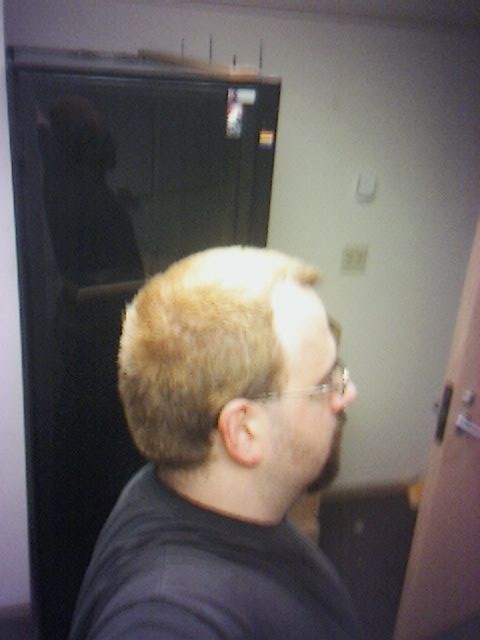
Realizing that I will get even less done once they come, I have selected a new, easier-to-maintain haircut.

Getting a good picture of it seemed hard, so I decided not to. Instead, here are these shots:


(See also my previous do).

Tuesday, January 17, 2006

Buying a car - class

With the news of twins, I have been working on buying a car. I think that I did a reasonably good job of handling the process, so I'm going to describe what I did here. I hope it can be useful to others.

The first step was to decide if we needed a car at all. Thanks to folks who commented here, helpimg me figure that one out.

Then we looked at how little car we might be able to get away with. For example, could we buy a larger sedan? It was easy to do some measurements and see that we couldn't fit all 3 kids, in car seats / boosters, across the back row. However, what if we put the big kid in the front seat, and the twins in the back? This is fine as long as there is only one adult. I figured that most trips only have a portion of the family, so using 2 cars for whole-family trips would be tolerable. However, the law in WA state will change next summer to say that kids can't sit in the front seat. And it's safer in the back, too.

It didn't take long to eliminate station wagons, either, as they wouldn't fit the 3 kids across.

An SUV that could fit us all (think 3rd row) would probably have terrible fuel efficiency, and conserving fuel is important to me. I also want to spend less, and put less weight on the road.

So, that means a minivan.

Saturday, January 14, 2006

What have I done?

First they see this:


Then they do this:


It's all my fault.

Two different outlooks

I have this memory from my youth. I was probably 10-11 at the time. My brother would have been 4 or so.

My parents both worked to make sure I could go to a private school. The school didn't have bus service, like US public schools do, and it was on the other side of the city, in the expensive part of town (of course).

This particular day, my dad was driving the car, with all 4 of us in it. (I think my Mom's car was broken that day?). This is a city criss-crossed by interstate highways. We were approaching the point where you get to choose between highway or local streets. My parents started to argue about which way to go. The argument was about much more, however. It was about the way they thought about how to live life.

For my dad, the obvious choice was the highway. It was fast and efficient. Sure, the highway was ugly & ruined the natural lay of the land, but as long as it's there, you may as well use it. As he likes to say, you can take from the system what you want. He knew that his mission was to get to work, and start doing his job, providing for his family.

For my mom, the right choice was the local streets. They're more interesting. You get to see the different neighborhoods, and how people live in different part of the cities. Every day you can take a slightly different route, and you never know what you'll find. (My mom knew every thrift store in the city). It made the trip a valuable part of the day. It also was a way of saying "yes" to local, varied life instead of "yes" to the anonymous highway.

My dad rose to be president of the European subsidiary of a small software company. He figured out how to play the game of corporate life, and played it well. He is financially secure. He thinks of himself as a radical, though, because he doesn't take the game seriously, studies yoga and meditation, and only takes from the system what he wants, instead of doing what the system tells him.

My mom seemed to always take some of the most difficult nursing jobs available. Hospice, home care, etc. They never seemed to pay well. Every now and then a better paying job might come along, but even if she took it, she never adjusted her lifestyle to match. She never ate out. Her house was always small & cramped, and most of the work on it she did herself. This was all deliberate. Any time she didn't like the way things were done at a given job, she always knew she could just walk away. She could choose to do the most meaninful work she could find, without having to compromise for money.

I am a bit of both.

Yoga of Eating

I just finished reading The Yoga of Eating by Charles Eisenstein.

My first exposure to his writing was in his article, The Economics of Fermentation (a variation in Wise Traditions), mentioned in a previous post.

Something about his writing always seems to ring true with me. Perhaps he's saying things that I know but can't articulate yet. Or perhaps he has an attractive writing style. Or something else, I don't know.

There are some ideas in this book that have really got me thinking. I won't go in to detail now, just listing a few.

  • Changing one thing means changing every thing.
  • If you listen closely to your body, it will tell you what nutrition it needs. If you hear it saying "eat cake", then eat cake!
  • The way that our modern lives feel so busy, so hectic is not an unfortunate consequence of our lifestyle, but a central feature. In software we say "it's not a bug, it's a feature".

More to come.

Ginger soda - mixed results

This week I decided it was time to try the ginger soda I had started in December. Some mixed results that I don't fully understand, so I'm going to go in to a lot of detail here.

A friend had made a good batch of ginger soda & given me a bottle. After drinking most of it, I saved the sediment at the bottom in my fridge, for some months.

When I was ready, I mixed 1/2 of the sediment with water, grated ginger, and white sugar. (I wonder if the mineral content of rapdura would work better. Yeast needs nutrients.)

I keep my house pretty cool in the winter, at least by US standards -- 62deg F (17deg C). I've noticed that at this temperature many of my cultured foods go pretty slowly. To help the culture along, I put the jar in the oven with just the light on. Recently I measured with a thermometer, and it's probably about 80deg F in there.

Every day I added more ginger & sugar to feed the culture. As it grew, I split in to two jars to keep one in reserve.

Finally the big day came. I boiled 1.5gal filtered water w/ a stick of fresh ginger, grated. Then added sugar (don't remember how much, but it was sickly-sweet). Let it cool, which took a while.

First vessel was a 1gal apple cider jar. Poured in 2qts of the mix, through a plastic funnel. Added filtered water to 1/2in from the top. Put a latex balloon over the mouth to measure CO2 production and restrict oxygen exposure. There are special devices for this, but I didn't have one.

Then I juiced a few fresh, organic lemons and added to the mix (but not in the first vessel). A friend is allergic to citrus, and he loves ginger soda, so this one was for him.

Second vessel was another 1gal apple cider jar. Again, 2qts of mix, add water. Another balloon.

Third vessel was a 1.5L Grolsch bottle, with swing-top (aka bail-top) lid. This is the only one that isn't clear.

Forth vessel was a 1/2gal jar that Kevin bought me at IKEA. A thoughtful gift from a friend. It has a wide mouth with a swing top.

3 of the vessels have narrow mouths, so they're hard to clean. It's possible that the insides weren't spotless. I am sure I had rinsed them out very well, so I don't think there was much soap or anything, but maybe some dried-on stubborn matter was still there. They looked clean to the eye. I now own 2 bottle brushes that should work well in these containers, and an in-sink bottle washer.

The vessels went in to the guest room where they wouldn't be disturbed. (Why do I own an entire room that is only used for 2-4 weeks per year? Topic for another blog.) Every day or two I checked on them, and vented the balloons if they were full. Here's how it went.

Vessel #1 (no lemon) never produced a single bubble. After a full month, the balloon had been sucked in slightly. A bit of mould grew on the surface. Dumped down the drain.

Vessel #2 started bubbling very soon. It made the balloon stand erect 3-4 times. Then it went quiet. At one point I tried moving it to a warmer part of the house, but it never produced more gas.

Vessel #3 (Grolsch) showed no signs of fermentation for at least 2 weeks. Then it started to bubble, and was active for the last ~3 weeks.

Vessel #4 (jar) followed the same pattern as #3.

This week I opened #3 and tasted it. It was excellent, so I decided it was time to check the others.

#4 was also good. Moved it to smaller bottles & gave them to friends.

#2 was still way too sweet. Why would the culture go inactive, when there was still so much sugar available? I added a little bit of #3 to provide a healthy, active culture. Put the jar in the oven with the light on. It became somewhat active again, but not as much as I would have hoped. It's still sweeter than I'd like, but perhaps people who drink soda every day will enjoy it. (My taste for sugar is much more sensitive these days).

So, why these variable results? Why did #2 go dormant? Why did #1 never get going? Any ideas?

Saturday, December 31, 2005

We flip for rock 'n roll


According to the ultrasound, one of the babies is currently head-down, and one is head up. They say that the babies will turn towards sound, so we applied some Neil Young.

Monday, December 26, 2005

Carless in Seattle

I'm having myself a little thought experiement. Could we live without a car?

Of course, really the question is "could my wife + 3 kids live without a car, in Seattle". It requires a great deal of tact to explain to someone why you are taking away their car, and why they'll like it. And I don't have a lot of tact...

We live in the suburbs now, but suppose we lived in the city? My understanding of city life is that things are easier to walk to than to drive to. And that buses in Seattle are very good.

Remember that we're talking about TWO newborns and a very active 4 year old.

Anyone reading this that has lived carless in the US with a family? Any advice?

The growing family

A bit of news for my readers: our family is growing. New baby coming, and all that. Should be arriving in a month or so.

As part of this, I've been trying to figure out some logistics.

For example, we have one car, and like it that way. Can we fit 4 of in a Saturn SL2? I like taking the bus to work. I'm slightly more likely to walk or bicycle places, and I certainly could use the exercise. When my son & I ride the bus to a museum or something, the bus ride is part of the adventure. I never have to pay for parking in the city. I'm reducing my contribution to traffic, fossil fuel consumption, noise, and air polution. I don't have the stress of negotiating rush-hour. I can read on the bus.

Living in suburbs makes the no-car thing a bit harder. There are fewer busses that pass my home. Everything is a little further away, as you have to walk past homes with yards & cross wide streets to get to it.

We just got some news this past week. We're having twins. I'm still feeling a little stunned. We'll be a family of 5! Suddenly I have to repeat all the logisitcal planning...

5 of us certainly won't fit in the car we have, if you remember that 2 of the passengers will be in rear-facing infant carseats for 18 months. In fact, there aren't a lot of cars that will fit all of us. We'll be trying out some station wagons, but it may be too tight. Could get a crown vic and own the road. :-) Otherwise, it's minivan time.

Friday, December 23, 2005

An attempt at spelt pita

My son may have a wheat sensitivity, so we've been trying to keep wheat out of his diet. Good pita bread is an food for me - something I grew up eating. So I decided to try my hand at a spelt pita.

I asked my arabic grandmother to help me make some. She was used to refined wheat flour, and we were using a strange oven, so I'm not surprised it came out a bit odd. I did get a picture.

Old paint

While doing work around the house, I found myself in the middle of another task.

One thing we've managed to collect in this house is old paint.

When you paint a room, you think "I'll save one can of this extra paint, for touch-ups". I don't know how realistic that is - I can't think of a time when we've touched up a room, at least beyond the first week after painting it.

Anyway, the collection was quite... extensive.

Some of the paint was clearly in bad shape, and that I'll get rid of.

However, there are many cans of paint in various colors that might be useful, just not to me. Perhaps you want to paint a wooden box to be a play prop for a kid. Or you are in a theater group, and want to paint props there.

If you have an interest in taking this paint off my hands, let me know.

What I mean by 'debt'

I mentioned the idea of 'debt' in my previous post.

I picked up this idea from the Agile software community, where they call it "Technical Debt". Let me attempt a definition:

- When an activity creates an unmet need, that need is a 'debt'. As long as that need is unmet ("the debt remains unpaid"), you continue to incur increased cost ("interest").

Here's a simple example. I cook breakfast for my family. After we eat, there are some dirty dishes. I could wash them now, or leave them until later. If I leave them, the food will dry on, and it will be harder to wash them later. If I try to cook something else in the kitchen, I have to work around all the dirty dishes in my way, which makes the new task more expensive, too.

Just as with financial debt, it sometimes makes sense to pay it off now, and sometimes to wait and pay later (with interest). For example, if I need to get to work early, then it may be worth it to leave the dishes.

With my finances, I don't live with debt. I don't have a car loan, or an ongoing credit card balance, or unpaid student loans. Partly this is because I am fortunate enough to make a good income, but many of my coworkers spend all their money & more, and end up in permanent debt.

BTW, the one debt I do carry is a mortgage. I think this is a wise debt to carry. We were already paying a rent before buying a house, so the majority of the monthly obligation is not new. The value for that money is high (large house + land vs. apartment). A very small portion of each payment goes to the principle, so it's not lost. The tax breaks from owning a home are very good. Most importantly, the value of the home has increased substantially, causing a major growth in equity.

Working at home

I took 2 weeks off for vacation at the end of the year, and decided to use one of them to work on the house. I asked my wife to make a list of all the things she'd like me to do - painting, hauling, electrical, whatever. We'd prioritize, and then I'd spend a full 40 hour week doing it. The second week I planned to relax.

Obviously, part of the goal is to pay off some of the accumulated debt in the house. (Not a financial debt, but a need that I created at some point.) The other part of the goal is to see how it feels. How much of this work can I really expect to do myself? What can I learn to do, and do successfully? Will I be able to stay motivated enough to do this work? Will I always need to pay an expert?

I've been doing that work all this week. It has gone well. The biggest surprise is how each task generates more tasks.

For example, there was "seal the grout around the tile in the downstairs bath". While doing it, I noticed some tiles that were really loose. They came off with 2 fingers. Underneath, I found that the drywall had rotted away some time ago, and someone had filled in the gap with some kind of cement, which also came out with my fingers. The drywall is quite mobile here, so to fix it, I'd want to pull out more & look in to bracing it better. Time to call a professional.

So, this means that the downstairs bath is not available for bathing, so I took a look at the upstairs shower. The water flow was always a bit low, even when we moved in 8 years ago. But both it and the adjacent sink had gotten *really* slow for hot water recently. We have steel intake pipes, which are about 45 years old (they won't last much longer).

I disassembled the shower head and cleaned it out. While it was off, I turned on the shower, and the water flow was high. And brown. Rust was pouring out in the water. Once it turned clear, I jiggled the faucet, and more brown came out. Kept doing this until it stayed clear.

Reassembled the shower head, and now the shower has acceptable flow.

However, with all that water coming out so fast, now the drain doesn't do it's think fast enough, and the shower fills with water.

As I was removing the drain cover, I dropped one of the screws down it. Now I need to go buy the exact right screw to fix it.

Cleaned out the gunk from the drain that I could see, but it still doesn't drain fast enough. Next step is to grab the plunger.

Figured I should clear the downstairs bath drain as well, so I opened it up. Could see gunk, but couldn't really reach it. Regular pliers couldn't, either. I knew I had needle-nose pliers, but couldn't find them.

Pulled all my tools out of my tool area and sorted them. Spent a few hours figuring out how to arrange tools. I don't want duplicates of everything, and I'm not very good at keeping things organized as I use them. In the end, the overflowing shelves of tools became neat & clean, with some shelves empty. It was amazing how much trash I pulled out of there.

The biggest collection in my tools working on electrical stuff. I have face places, 120V receptacles, Ethernet jacks, an insulated staple gun, fish tape, etc. I think electrical (both high & low voltage) is the kind of home work I enjoy the most.

Finally at the end of the day, I had pulled the gunk out with the needle-nose pliers.

However, the drains still don't work. That's for today.

Oh, and the TODO list is bigger today than when I started on Monday.

Sunday, December 04, 2005

Power on

In a continuation of yesterday's power adventures, today I did a some more outlets.

I made the 2-prong outlet properly grounded, as I mentioned.

I replaced 2 switches. The new ones are higher quality, so I'm feeling good about that, too.

I went to do the last outlet, and ran in to trouble. When I went to screw in the new outlet, I couldn't get one of the screws to take. The box was plastic, and the screw hole had stripped. Also, while working on it, I had cracked the box on the side, which didn't seem like a good thing.

I wanted to replace it, but it was securely fastened to a stud (good!). Actually, it was rivetted to a metal bracket which was nailed to a stud. I was able to get behind a wall in another part of the house to get an idea of what I was dealing with.

I basically demolished the box with random tools, pulling out the peices as I went. Then I used a prybar to pull the nails out, which was a HUGE PAIN IN THE ASS.

Once that was done, and my ass had recovered, I installed the new box, new outlet, etc. All good. I also stopped to praise my choice to buy some extra gang boxes yesterday.

Other interesting notes from the experience:

- 2 of the walls in the kithen had wallpaper, which was painted over. Bad. Some of it tore while I worked, and now there's a white blemish next to a light switch. Need to touch that up.

- While working on the plug that I didn't get along with, my 4-year-old flipped some breakers. Scary.

- I actually did manage to give myself a little jolt. It wasn't fun, but it wasn't exactly painful.

Time to pause being an electrician. Tomorrow I go back to moonlighting as a software developer.

Saturday, December 03, 2005

power corrupted

(This is a bit of a departure, topic-wise, for my regular readers. It'll be interested to see if it resonates with anyone.)

As part of my work in the kitchen today, I replaced two power outlets. We had already decided to freshen them up, to make them all white & matching. These two were quite an experience, though.

First, they appear to each be on a dedicated circuit.

One has relatively modern 2 conductor + ground, 12ga wire. What's odd is that the breaker is 30 amps! If I could convince myself that it really was a dedicated circuit, I'd replace the outlet with a 20 amp one, which might be nice to have.

The other one has the same wiring as the rest of the house: It's all 12 ga, with cloth insulation. The ground wires never go in to the gang box in the whole house. That seems weird to me, but maybe that was how they did things back in 1959. (yeah, my house is ancient!) In this one case, however, the ground wire was screwed in to the back of the gang box, which was metal, so the outlet could be grounded. Everywhere else the gang box is plastic, and the outlet is 2-prong.

On top of this, the gang boxes were just screwed in to the drywall with wood screws! Not even with a drywall anchor. So as I starter my work, the screws pulled out of the wall. Uggh.

Off to the hardware store to buy some old work gang boxes. Had to cut out the wall a bit to fit the boxes just right. In the end it all went back together fine, and looks good.

Tomorrow I replace the other two outlets in the kitchen. One is 2-prong, even though the gang box is grounded (I tested). So it'll be going to 3-prong.

Weird wiring in this house. And I'm still trying to make sense of the 30A breaker on the 12ga wire...

back in the salad again

While in the Far East, we had some work done on the house. In the kitchen we had the cabinets refaced, a new countertop, a new cooktop, and a new floor.

So before we left, we had to pack up everything and empty the kitchen completely. This, at the same time as packing for a trip. (We also had to empty the family room, but that's for another blog.)

When we came back, the kitchen wasn't quite done (as expected). We were able to use it, but we couldn't stock it yet.

Finally on Thursday the work was done. We cleaned up after the work (mostly sawdust), and now the kitchen is ready for the stuff to come back.

However, we're trying to reduce how much stuff we have. One of the techniques I've used a couple times is to take away a bunch of stuff, and then see what comes back. Whatever's left after a certain time period goes to the thrift store. So instead of unpacking all our stuff back in to the cabinets, the kitchen is full of boxes of as-yet-unused stuff.

To make things more interesting, we decided not to bring the microwave back in to the kitchen. Furthermore, we found out that the dishwasher is kaput, and the new one is still on the way.

This means that all heating of food is on the stove, and all washing is by hand. Is it possible to live in the suburbs in 2005 with neither a dishwasher nor a microwave? Well, we'll find out.

Today was a big day. I got the ginger soda starter & kefir going again. I started a batch of yogurt with a starter I brought from my grandmother. I set up an oatmeal ferment for breakfast tomorrow. And I replaced two power outlets.
 
Creative Commons License
This work is licensed under a Creative Commons Attribution-NonCommercial-ShareAlike 3.0 Unported License.